

Honoured and dishonoured
What honours mean to me personally, and how to nominate someone
In today’s Gazette (forgive me the length):
The President stripped of honour this week
My own stolen honour and my audience with Queen Elizabeth II
Protocol for professionals: diplomatic convention, how to nominate someone, what honours mean, what to do when you’re nominated
Thank you for subscribing to Ambassador at Large. My work for you is independent and free of sponsorship, advertising or other income.
If you appreciate it, taking out an annual paid subscription will help me cover costs and keep it going.
Dishonoured
If protocol is a vital part of diplomacy, the award and withdrawal of honours are a powerful lever. They were in the news this week for the wrong reasons.
That’s my prompt to write about personal experiences, and explain the system and how you can use it.
The white eagle
This week, Poland took back its highest honour from a Head of State.
President Karol Nawrocki stripped Volodymyr Zelensky of the Order of the White Eagle.
In late May, Ukraine named a military unit after the Ukrainian Insurgent Army, which many Ukrainians honour for its role in their fight for independence.
The UPA also carried out massacres of Poles in Volhynia and Eastern Galicia which Poland classifies as genocide. What signal was Zelensky sending to Poland?
He sent the insignia back by post.
Ukraine’s Foreign Minister Andrii Sybiha also said last week he’d return the Commander’s Cross with Star of the Order of Merit.
Kyrylo Budanov, head of the Office of the President, returned the Gold Officer’s Cross of the Order of Merit, that Nawrocki awarded him last year.
[Stripping Zelensky of the honour is] “a gift for the Moscow aggressor, which it will certainly use against both our countries” - Kyrylo Budanov
Effective diplomacy must understand history, culture and symbolism.
A state award given to a foreigner is a tool of statecraft. It marks a relationship between two countries through a person who happens to be officially representing one of them.
Give it, you publicly signal trust.
Take it back, you publicly signal disapproval.
Public disapproval between two allies fighting a war against a common enemy suggests failures of diplomacy on both sides.
The dispute should never have happened, and when it did, it should not have escalated to open animosity.
A decoration costs the giver little and gently ties the recipient to them.
Taking one back is rare. In more than 300 years, the Order of the White Eagle had been forfeited once.
Nawrocki acted only after consulting the Council of the Order, which governs the decoration. Whether his decision holds without Prime Minister Tusk’s countersignature is disputed.
Poland has been hosting the Ukraine Recovery Conference yesterday and today. Both Tusk and Kyiv asked Nawrocki not to escalate.
Ukraine’s foreign minister, Andrii Sybiha, called it a strategic mistake and handed back a Polish award of his own.
Honours given and honours returned are a language. Cheaper than sanctions, louder than a démarche, and critically if you believe in “tit for tat” diplomacy, a one off signal that does not need to be repeated.
The white elephant
Each honour has its own weight and symbolism. Sometime the name itself invites controversy.
Some have suggested renaming the “Order of the British Empire”, for understandable reasons.
There are also good reasons to maintain the name as meanings and practice evolve. The OBE had meaning to me.
My affection for the Thai “Order of the White Elephant” comes from being nominated, “Fourth Class”.
I feel the “Order of the White Elephant, Fourth Class” might neatly sum up my diplomatic career.
Alas, I did not merit it.
This was during a State Visit by HM Queen Elizabeth II to Thailand. When the proposed nomination lists were (sensibly) shortened, my name was one that came off.
For the work on that visit, running the media, The Queen conferred the distinction of LVO. My own sovereign, for service to my own country. What more could I ask?
Her late Majesty invested this honour on me at a private audience in the Grand Palace in Bangkok.
Although during the visit I’d spent time alongside her at events, and escorted her through a reception for journalists, a private investiture in that setting was itself an honour.
She told me how hard I’d worked on an impossibly complex media programme in Bangkok traffic gridlock. I said how hard she’d worked through a full royal programme in the tropical heat.
As well as the insignia, which I treasured until it was stolen 20 years later, she also bestowed on me a pen I still use, and a Royal Encyclopaedia that sits on the shelf behind me as I write, with a generous letter from her principal press secretary about what I’d done.
There was also a framed signed photograph of her and the late then Duke of Edinburgh.
Visitors to British Ambassadors’ Residences will often see signed photographs of royals they’ve hosted, displayed on a prominent shelf or grand piano.
(After a visit to Seoul by Andrew Mountbatten Windsor, the former Duke of York gave me one loose. They’d run out of frames. He suggested I might pin it to a wall and throw darts at it.)
On that same day, a founder member of this Gazette stood ahead of me in the ante-room queue for our audiences.
As Ambassador he’d carried off the visit with aplomb, at a difficult time for the royal family, and is now “Sir”, carrying the letters KCVO (Knight Commander of the Victorian Order).
22 years later, I played a similar role when, as Ambassador to Cuba, my team organised a royal visit (“State Visit” for the hosts). Before Charles and Camilla departed I stood at the head of a queue for an audience in “my own” Residence in Havana.
By that time I’d became wary of foreign honours. An award to a diplomat recognises the country he represents, not her/himself.
Had I not represented my country, I would not have been in the room.
That did not stop me accepting an award from the Vietnamese government, to reflect a newly-established strategic partnership between our two countries.
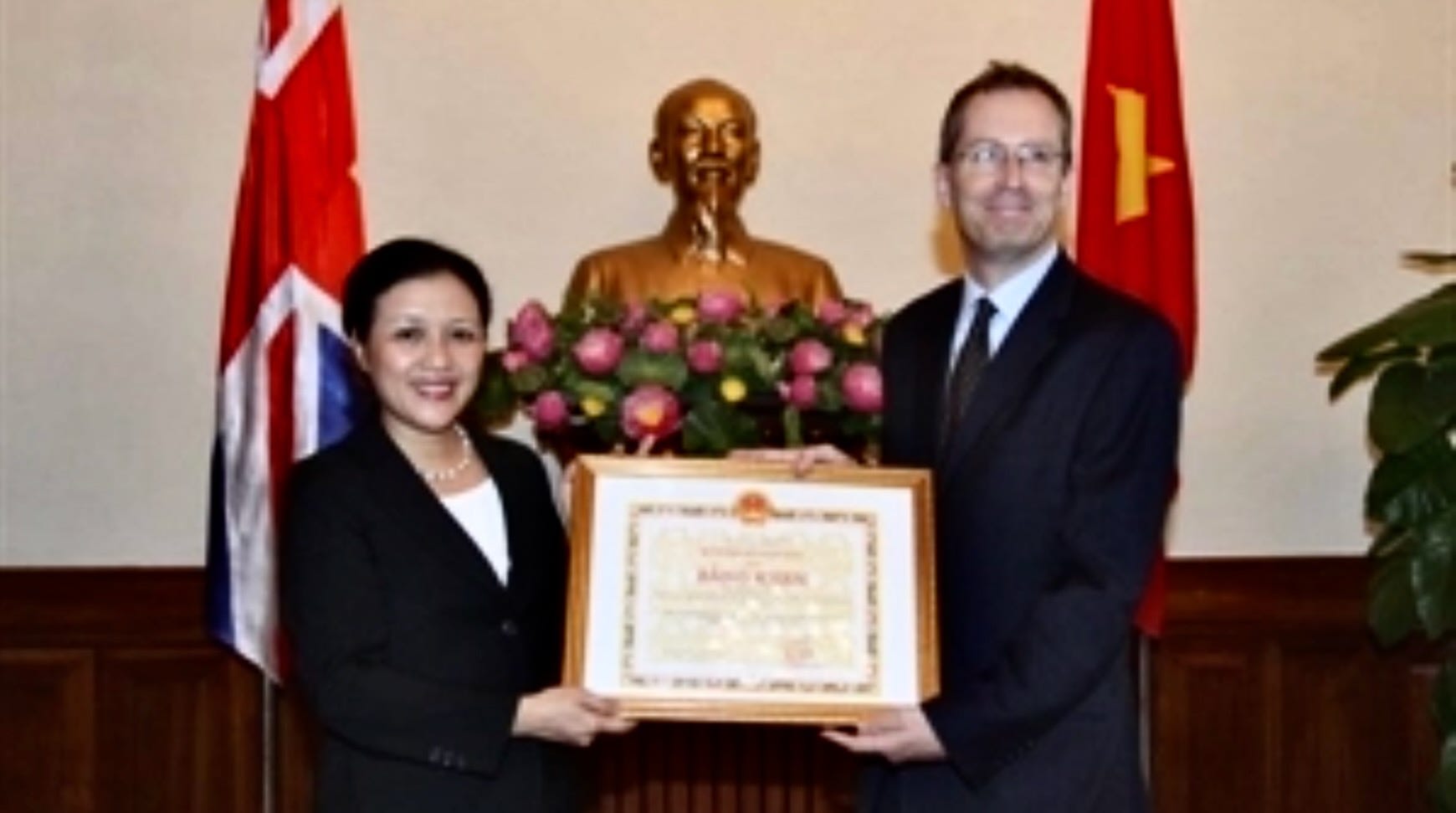
Deputy Foreign Minister Nguyễn Phương Nga, Hồ Chí Minh and me. The unusual presentation was of the Vietnamese certificate of merit for exceptional contribution to the Vietnam-UK friendship, which I accepted.
Take care with the background of photographs. This is also an example of flag protocol: see the Gazette of 2 October. “What matters most [for flags]: equal height, equal size, equal light.”
Protocol for Professionals
Diplomatic Convention
What to do when the honour comes to you
What happens when honours are stripped
How 7 countries do it differently
Guide to UK honours
Tempers boil over at the UN